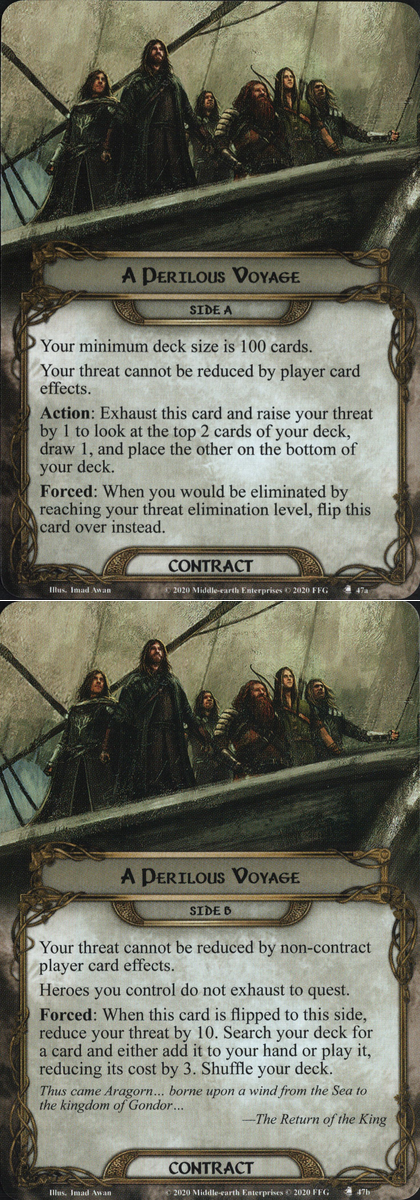
TL;DR: A contract that enables massively flexible decks, with a mid-game power spike to drive you on to victory.
The least popular of the official contracts, based on the number of decks published with each contract at the time of writing. Conventional wisdom suggests that most decks have a handful of key cards, and reducing your deck to as close to 50 as possible is key to getting those cards early, when they'll make the most impact. But a 100-card deck? Who would hope to run such a deck and expect consistency?
Well, A Perilous Voyage has a few tools to help with that. First, the ability to raise your threat by 1 to perform a filtered card draw — look at your top two cards and draw one, placing the other on the bottom of your deck. This is card draw that is guaranteed to start in play, and it can be very effective. Deep Knowledge, in a solo game, trades two threat to net you one card, remembering that you used a draw on Deep Knowledge itself, and is still an incredible card in any deck that can stomach a threat increase and contains lore. This is a better Deep Knowledge that you can use every round, until you hit 50 threat.
Speaking of hitting 50 threat, once you hit your threat elimination level, you lower your threat by 10 (equivalent threat reduction as two copies of Favor of the Valar), and now your heroes don't exhaust to quest. This is fantastic for heroes with multiple good stats, like Gandalf, Aragorn, any of the 2/2/2 heroes, Éowyn with a Golden Shield or Herugrim, and many others. Additionally, you grab one card from your deck, and you can play it at a discount of 3. That can be a free Sword that was Broken, or Herugrim, or Forest Snare, or Steward of Gondor, or a deeply-discounted Path of Need, or any key card you weren't able to find earlier. These effects are strong enough that rocketing up your threat with the card draw from the contract, as well as other doomed cards, is an entirely valid strategy to take control of a scenario. Once you have that control, you're not likely to cede it back.
So how do you effectively make use of this contract? The lack of threat reduction (beyond the effect from this contract) isn't an issue in terms of elimination for most scenarios, though for extremely threat-heavy scenarios, or if you're playing with The Power of Mordor encounter set, or if you're playing Ghost of Framsburg, you will want to keep your starting threat in mind. But that lack of threat reduction does mean you need a deck that's combat ready, because pretty soon almost every enemy's engagement cost will be below your threat. You'll also want card draw beyond what the contract provides, and an engine to play all those cards. Cards that let you search your entire deck, like Word of Command, Heed the Dream, or Gather Information, can really help get that engine going.
Most of this has been about how to mitigate the inherent inconsistency of a 100-card deck. But what about the advantages of bringing 100 cards? Adding good cards to any deck can help that deck become more flexible, and with 100 cards, your deck can be massively flexible, with space to bring cards to meet any sort of challenge. Maybe you want to play an archetype that can be played well in several different ways, but you want to be able to use each aspect of that archetype. I'll use Dúnedain as an example. It's very difficult to fit in all four allies that scale infinitely with the number of enemies engaged, generically good allies like Ranger of Cardolan, Misty Mountain Journeyman, and Northern Bowmaster, healing, traps, defensive attachments for your heroes and/or allies, shadow cancellation, cool Dúnedain-focused events, card draw, resource acceleration, maybe other toolbox cards like Distant Stars, and maybe even some side quests and Vigilant Dúnadan, when trying to hit 50 cards. But with 100 cards, just throw it all in and play the cards that will be useful at that moment in the scenario you're playing. With the excellent draw from A Perilous Voyage, you should have a card in your hand that will help.
Another advantage of a 100-card deck is the variety it brings. Rarely will you have a deck feel stale when you have twice as many cards to play. The bonuses from the contract let you play a deck that doesn't feel like it's a pure, optimized machine, built to excel at a single task, but rather you have a strong, fun deck that plays a little differently every time you bring it to the table.
The biggest real downside is shuffling. All those deck-searching cards that go great with a 100-card deck, but then you have to shuffle all those cards you didn't grab.