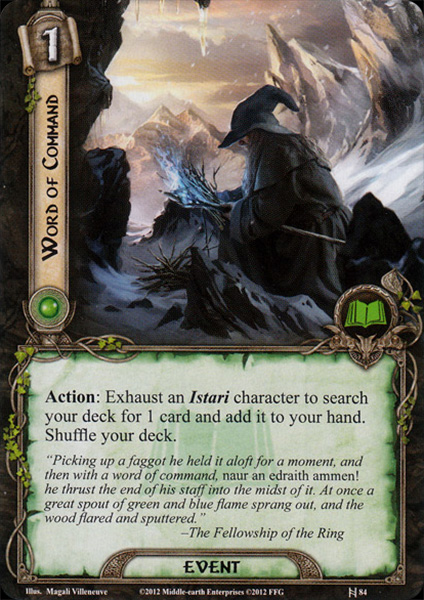
Word of Command

Event. Cost:1.

Action: Exhaust an Istari character to search your deck for 1 card and add it to your hand. Shuffle your deck.

"Picking up a faggot he held it aloft for a moment, and then with a word of command, naur an edraith ammen! he thrust the end of his staff into the midst of it. At once a great spout of green and blue flame sprang out, and the wood flared and sputtered." The Fellowship of the Ring
Magali Villeneuve

The Long Dark #84Lore.

Word of Command
Reviews

Word of Command is a card which can often seem better in theory than in practice. In the right deck it can be pretty amazing though. So let's take a look. You get to search your entire deck for any card of your choice and add it to your hand. That's incredibly powerful. However it does require you to exhaust an Istari character, and there aren't many of those in the game - only Gandalf, Radagast, Gandalf, Saruman and Gandalf. Hero Gandalf is obviously the most reliable option but that means you're using up a hero action on this - specifically the action of a 14 threat hero with powerful stats which you might want to use or indeed be relying on using - though those stats mean you may already want to give him action advantage with Unexpected Courage or Shadowfax. Core Gandalf and Saruman are temporary allies - though handily if you can wait you can use Word of Command in the refresh phase after characters ready but before the temporary ally is discarded. Hobbit Gandalf is a pretty good option if you can stomach the threat, since he has built-in action advantage, but as noted, threat. Radagast has no downside but isn't particularly useful in general, and as useful as Word of Command can be, it's probably not worth playing a 5-cost ally for no other purpose.

If you can manage the cost though? Any card from your deck for that exhaust plus 1 resource is a pretty good deal. An obvious and significant use is that you can use it to grab any of those cards with the annoying "Limit 1 per deck" restriction if you wnt to use them more reliably. Path of Need is an obviously powerful choice, but I'm also somewhat partial to The Fall of Gil-Galad for shenanigans. Justice Shall Be Done would also be a great shenanigans option. On the other hand, you can also use it when you simply need/want a particular card at a particular time, like wanting A Test of Will for security, Feint when you have too many attacks, that sort of thing. Or of course, finding crucial cards for your deck when you haven't been lucky enough to get them in your opening hand/mulligan/early draws. Like Light of Valinor, Steward of Gondor, Master of the Forge or other such mulligan cards. In a pinch, if your hero Gandalf deck likes its action advantage, you could make a case for exhausting Gandalf for Word of Command to grab Unexpected Courage which you can then play and ready him, leaving you with the same number of actions you otherwise would've had for that round, but one more in subsequent rounds for the rest of the game.

The main reason Word of Command can be viewed as less useful in practice than in theory is that often a lot of decks will prefer to use cards which let them draw a higher number of unidentified cards rather than a single specific one. With the ability to just draw 2 for free with Daeron's Runes or Deep Knowledge, or 3 for 1 in the right deck with Mithrandir's Advice, paying 1 and exhausting a very powerful character for only one card may not seem like such a great idea, unless it's a particularly useful card. Add to that the fact that while Word of Command is cheap, unless you use hero Gandalf it's a 2 card combo and thus less reliable. Ironically one good use for Word of Command would be to find combo pieces, but it is itself a combo if triggering it with one of the allies, so you have to open the box with the crowbar you find inside.

Despite all those difficulties, I really like Word of Command and wonder if perhaps I should use it more often. With the allies it's unreliable but can be a useful option, with hero Gandalf it's incredibly potent if you can cope without the action. Worth consideration at least.

I guess that right now the best user of this card is hero Saruman (and its easy built-in readying effect), especially to find its Staff and other key card (perhaps some shenanigangs with the Fall of Gil Galad too). — Alonewolf87 2817

This is a card that's gotten better throughout the life of the game. An entire deck search for any card is undeniably powerful. The only other cards allowing an entire deck search for any card are Gather Information, an extremely solid and splashable card whenever playing a quest that doesn't punish you for running side quests, A Perilous Voyage, which has the cost of the contract (100-card deck and no threat reduction besides the one-time ten threat drop), and Heed the Dream, which costs 3 leadership resources for that search, on top of the one lore resource that gave you a card from the top 5 of your deck. Comparing to Heed the Dream, we can make the argument that it's a difference between 3 leadership resources and one lore resource plus exhausting an Istari character.

When this card first came out, the available characters to exhaust were Gandalf and Radagast, and very soon would include OHauH Gandalf. Of those, Gandalf was always good and would be in most decks, Radagast was a good way to weigh down your deck, and Gandalf could be excellent in select decks that build around him. Radagast's stats are low enough that exhausting him isn't much of a cost, but again, he's not likely to make a deck. With Radagast's Staff now released, if you're including Radagast in your deck you'd better also be playing Word of Command to ensure you find the Staff quickly. This might even be viable now, though unlikely to surpass hero Radagast. But I digress, I'll get to that excellent hero later.

So, on to Gandalf. Extremely high stats, so it can be painful to exhaust him. Fortunately, there are a few tricks, though none make this card an auto-include with him. There's an action window in the Refresh Phase, right after refreshing characters and raising threat. Excellent opportunity to play Word of Command. But, that presupposes Gandalf will be around, when his most common way of entering play is through Sneak Attack. You can always sneak him in and then exhaust him with Word of Command, but usually one wants to sneak him in before committing characters to make use of his , or during the combat phase to make use of his or . Rarer, though not altogether uncommon, are plays outside of these phases. If you do straight up pay for Gandalf and he's still around in the Resource Phase, that may be because you want to exhaust him for another card, namely A Very Good Tale, which he works extremely (and thematically) well with. Additionally, these are all multi-card combos, and none of these cards will be in play for more than a round, so using Word of Command with Gandalf is difficult, and often seen as more trouble than it's worth.

Then there's other Gandalf. If you build a deck around him, there will be rounds you don't need his combat abilities, so Word of Command is an excellent include so long as you have access. Probably the simplest case there is.

Let's move to the last Istari ally, Saruman. A very cool ally that I am guilty of ignoring. While he can be similarly snuck in like Gandalf, you often want to get something out of play for longer than a phase, and he isn't quite as good at telling tales, so he is a decent user of Word of Command.

Each of the above methods requires a multi-card combo. But, each of these Istari have also been printed in hero form, allowing you to start the game with an Istari to exhaust.

Gandalf. The ultimate hero. The highest threat in the game. The one I stick into just about any deck where I don't know which third hero to run and he makes it work. He's got access (as long as Word of Command is the top card of your deck), and a bevy of cards to fetch for himself (Gandalf's Staff, Wizard Pipe, Narya, Expert Treasure-hunter), as well as being able to grab that key card for whatever archetype you're running with him (even Vilya if you so desire). The only issue is that you have to exhaust him. However, many of these cards are so good that it's worth it, and it's likely you have Shadowfax and/or Unexpected Courage in your deck and going on Gandalf anyways, so at some point he'll be ready to speak that Word of Command.

Radagast comes with his own key card, Radagast's Staff. Additionally, he comes with his own action advantage, not exhausting to quest if you've played a creature that round, and he's in the sphere. If anything, he's even more suited to use Word of Command than Gandalf. Already found your Staff? Go grab yourself an Eagles of the Misty Mountains! Or a Messenger Raven! Or A Burning Brand! Or whatever else you may need.

Last of all, Saruman. Unlimited readying potential (well, until you hit your threat ceiling) and access. Easy peasy.

A note on two contracts: I mentioned A Perilous Voyage already in this review as a card that can search your entire deck. With 100 cards, that's needed. But that's not an early-game effect, so if your deck has a key card or two, stick Word of Command in as copies 4, 5, and 6 to help you find it. It helps that the action advantage A Perilous Voyage provides is excellent with Gandalf, okay with Radagast, and -- actually, no, get rid of Saruman with Helm of Secrecy before flipping that contract. If you don't, um, good luck.

But, if you think a 100-card deck makes it hard to find something, try Council of the Wise. Having 1x of a key card in a 50-card deck makes you less likely to draw it early than 3x in a 100-card deck. With just about every archetype having a key card or two, this becomes one of the hardest contracts to build a good deck with. Full deck searches help immensely, and thematically, the Istari should be on the Council, so this is another place this card is superb.

Sackmoney 730